RoboSwarm Acoustic Neighbor Identification
Senior capstone sponsored by URI's Intelligent Control & Robotics Lab. Designing a swarm of at least five ESP32-based robots that identify their neighbors acoustically, with each robot emitting a unique tone and running an onboard FFT to detect which robots are nearby.
Tools: ESP32, PCB Design, DSP/FFT, C++
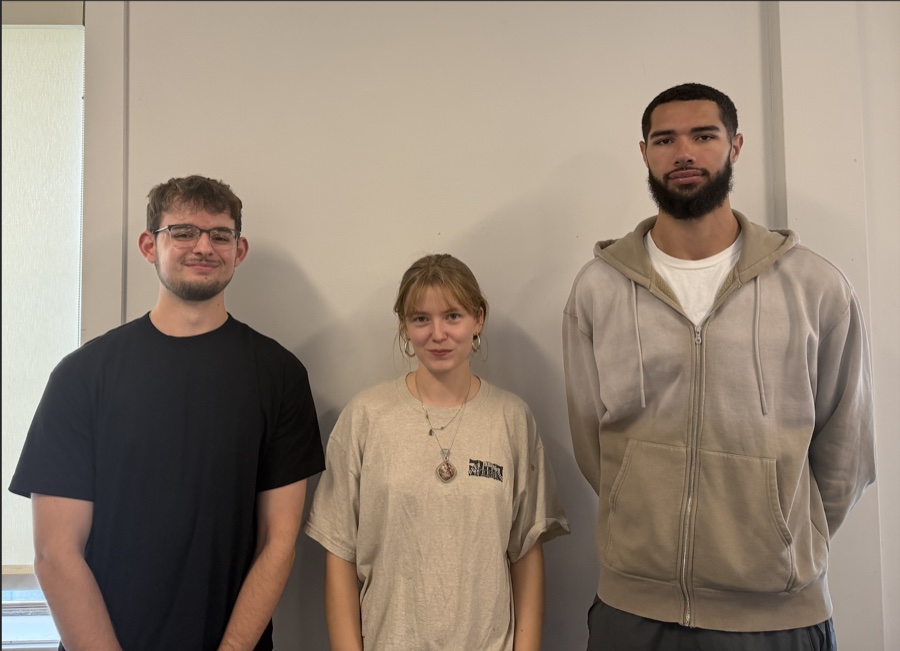
The RoboSwarm team: Maile Campbell, Cyril Burke, and Jacob Donovan
RoboSwarm is my ELECOMP senior capstone project (2026–2027), sponsored by the Intelligent Control & Robotics Lab (ICRobots) at URI. Robot swarms need a reliable way for each robot to recognize its neighbors, but most multi-robot systems rely on wireless communication, cameras, or LiDAR, which either demand significant computation and external infrastructure or become congested as the swarm grows. RoboSwarm is investigating acoustic signaling as a low-cost, low-bandwidth alternative: each robot continuously emits a unique tone while listening through a microphone, and identifies nearby robots from the frequencies present in the received spectrum.
My main role is hardware and PCB design. We are designing a compact circular PCB, roughly 15 cm in diameter or smaller, that integrates an ESP32 microcontroller, a microphone interface, a speaker amplifier, lithium battery power management, USB-C charging, and expansion headers for future sensors. At least five identical robots will be fabricated and assembled to test how the approach scales. Down the line, I'll also be supporting the experimental robotics software and the FFT-based tone detection running on the ESP32.
Once the swarm is built, we will characterize maximum reliable detection distance, robustness with multiple simultaneous transmitters, sensitivity to ambient noise and room reverberation, the effect of robot orientation, frequency resolution and identification accuracy, and computational load on the ESP32. If time permits, the platform will be extended with differential-drive motors, wheel encoders for odometry, and infrared proximity sensors, turning it into a reusable swarm robotics testbed for future research in the lab.
Built alongside Cyril Burke and Jacob Donovan.